Human Capital Acquisition in Response to Data Breaches
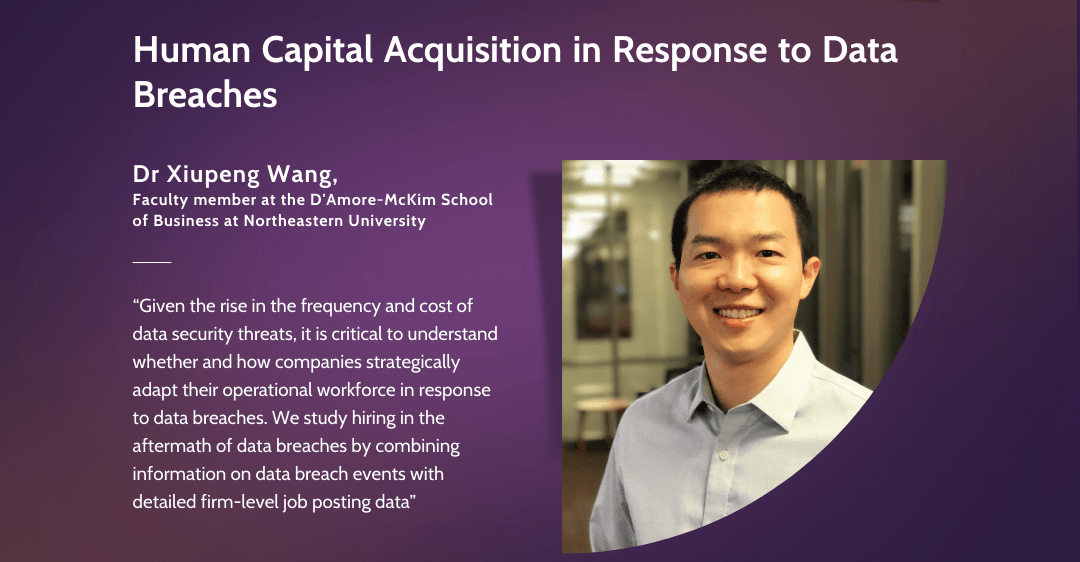
Presented by Dr. Xiupeng Wang
Dr. Xiupeng Wang’s research primarily focuses on the impact of emerging technologies, particularly recent advances in information technologies, on firms and the labor market. His current research studies how Information Technology affects organizational structures, firm sizes, and market concentration. His research also extends to cybersecurity to analyze firms’ human capital acquisition in response to data breaches. Through massive online experiments, Dr. Wang is developing a new measure of household production and finds the currently omitted non-market contribution to the GDP can potentially be greater than we believed before. He is also excited about using the matched employer-employee data from the U.S. Census Research Data Center to study the effect of high-skilled immigration. Dr. Wang received his Ph.D. in economics from the University of Connecticut.
Abstract
Given the rise in the frequency and cost of data security threats, it is critical to understand whether and how companies strategically adapt their operational workforce in response to data breaches. We study hiring in the aftermath of data breaches by combining information on data breach events with detailed firm-level job posting data. Using a staggered Difference-in-Differences approach, we show that breached firms significantly increase their demand for cybersecurity workers. Furthermore, firms’ responses to data breaches extend to promptly recruiting public relations personnel — an act aimed at managing trust and alleviating negative publicity — often ahead of cybersecurity hires. Following a breach, the likelihood that firms post a cybersecurity job rises by approximately two percentage points, which translates to an average willingness to spend an additional $61,961 in annual wages on cybersecurity, public relations, and legal workers. While these hiring adjustments are small for affected firms, they represent a large potential impact of over $300 million on the overall economy. Our findings underscore the vital role of human capital investments in shaping firms’ cyber defenses and provide a valuable roadmap for managers and firms navigating cyberthreats in an increasingly digital age.